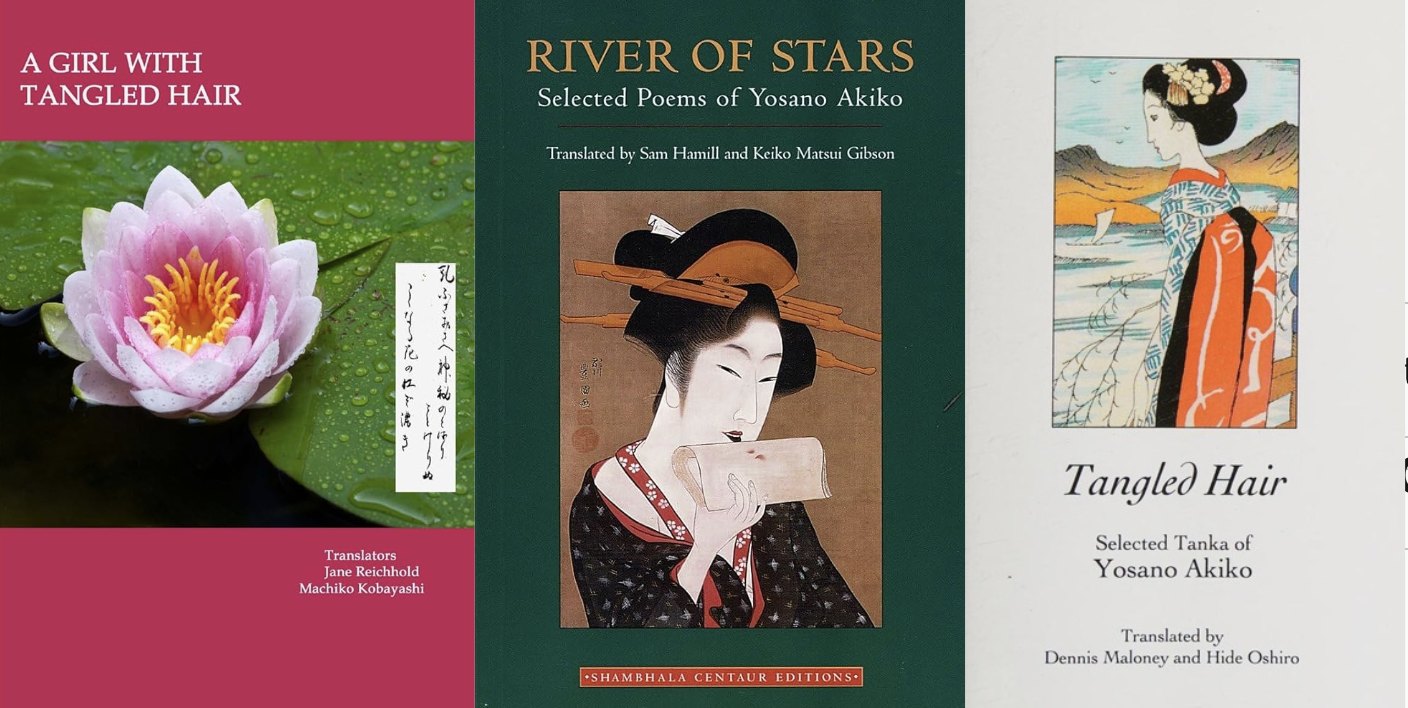
A Girl with Tangled Hair - Reichhold & Kobayashi
In the process of encoding and analyzing Akiko’s 399 tankas, the differences between each English translation became very apparent. The Reichhold and Kobayashi edition—the basis for this project—offers a poetic yet simplistic set of tankas. These translations typically use enjambed lines, only including punctuation for the purpose of asking questions periodically. The poems are written in lowercase text (aside from proper nouns), and many lines of the tanka can exist independent from the rest of the stanza—a technique often found in haiku poetry. In my own reading, I found this version the most romantic, as each tanka has a sort of wistful quality about it.
River of Stars - Hamill and Gibson
As we move to the Hamill and Gibson edition, I concluded that these tankas were the most “powerful.” The language is sharp, intense, and poetic, reminiscent of Robert Fagles’ translation of Homer’s Odyssey. This edition feels very familiar to other translations of Japanese writing to English, but it does leave some of the tankas feeling unnecessarily curt. These tankas, out of the three published versions, feel like the furthest departure from the Reichhold and Kobayashi translations.
Tangled Hair: selected Tankas - Maloney and Oshiro
This edition exists in between the two aforementioned translations, utilizing words with soft connotations and consistent punctuation. These tankas also incorporate the “independent line” idea found in the Reichhold and Kobayashi text, allowing many lines to feel free and unbound to their position within the stanza. Although I found A Girl with Tangled Hair the most helpful for a broad understanding of Akiko’s poetry, this translation feels the most similar to how English poems are traditionally produced. Reading through all of these versions are pleasurable experiences, and this translation leans in a bit to the reader experience.
ChatGPT & Google Translate
As I shifted attention to the ChatGPT versions, I noticed that these tankas retained some elements of the standard translations, but the authenticity was lost. To curate responses, I asked ChatGPT to “translate [these] ten tankas into English while respecting the style, structure, and artistry of the original poems.” In each of the resulting tankas, ChatGPT tried to adhere to a rigid syllable count (sometimes using 6-6-6-6-6), introduced a slew of em dashes in every translation, and selected words that were too literal or unnatural for the theme of the tanka. The translations could therefore provide a starting point for users interested in translation studies who lack the time or resources to more closely engage Akiko’s work, but ChatGPT’s edition leaves much to be desired. It loses the subjective, human quality: the voice that makes traditional translations special in their own right.
For writers about whom more scholarship is available, ChatGPT may be a better tool, more closely mirroring works that have been produced already. Akiko’s tankas, however, are not at that point, suggesting that ChatGPT (and likely other tools) is not yet compatible with in-depth Japanese-to-English translations of her work.
The Google Translate versions of Akiko’s tankas were, unsurprisingly, the most stilted. There is no way to prompt GoogleTranslate to format each tanka into the 5-7-5-7-7 structure, so each result becomes one long line of English text. Although the kana for tankas are typically written in one line, it is very rare for an English translation to retain this form.
Additionally, the word choice through Google Translate is incredibly literal. Expressions are obscured by Google Translate’s tankas that leave little room for interpretation and ambiguity: “teacher of the way,” for example, “becomes simply “my lord” this edition. Google Translate and ChatGPT may offer baseline readings of each tanka, but neither retains Akiko’s intentional, poetic style, creating translations that are significant departures from her original work.