Yosano Akiko’s Life: A Short Summary
1878-1942
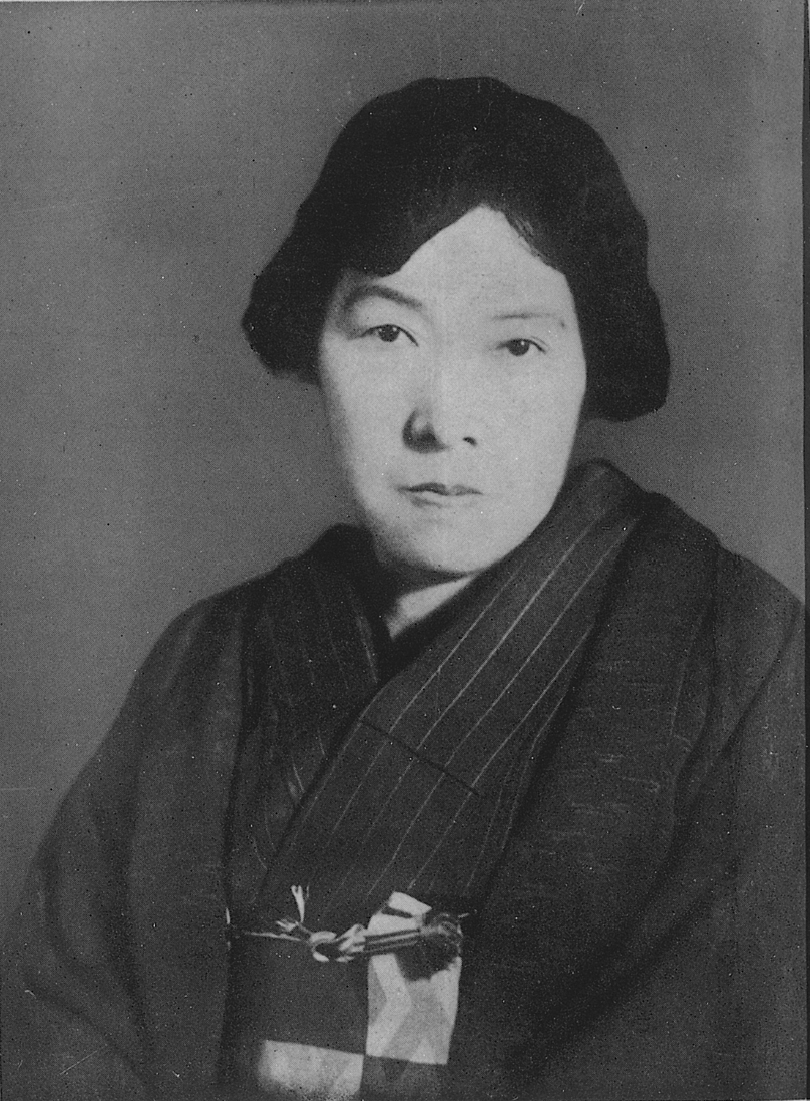
In pursuit of literary opportunities, Akiko moved to Tokyo as a young adult and began focusing on her craft and her career. While writing in the city, Akiko met Yosano Tekkan, a fellow writer and founder of the magazine Myōjō. Tekkan served as a mentor for Akiko, and eventually the two started a scandalous affair that led to Tekkan’s separation from his first wife and marriage to Akiko in 1901. Together, the two had thirteen children, eleven of whom survived into adulthood. The couple had a successful marriage until Tekkan’s death in 1935, writing alongside each other and producing a multitude of publications.
Scholars position Yosano Akiko as a transformative figure in the emergence of a modern, self‑assertive female poetic voice in Japan. Janine Beichman’s monograph is foundational in this regard, arguing that Midaregami (Tangled Hair) inaugurated “the birth of the female voice in modern Japanese poetry” by foregrounding erotic desire, emotional autonomy, and a personal lyric subjectivity (Beichman 42). This reading aligns with institutional biographies from the Japanese National Diet Library and the Poetry Foundation, which emphasize Akiko’s broader cultural role as a feminist, pacifist, and public intellectual. Together, these sources frame Akiko not only as a literary innovator but also as a central participant in the sociopolitical reimagining of women’s agency during the late Meiji and Taishō periods.
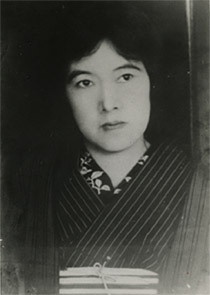
Biographical scholarship also highlights how Akiko’s personal life shaped her literary development. In pursuit of literary opportunities, she moved to Tokyo as a young adult and immersed herself in the city’s vibrant artistic networks. There she met Yosano Tekkan, poet and founder of Myōjō, who became both her mentor and eventual partner. Their relationship—initially a scandalous affair that led to Tekkan’s separation from his first wife—culminated in their marriage in 1901. The couple raised thirteen children, eleven of whom survived into adulthood, and maintained a productive literary partnership until Tekkan’s death in 1935 (Beichman 29). This biographical context, echoed in both historical and literary scholarship, underscores how Akiko’s emergence as a major poet was intertwined with Tokyo’s modernizing cultural sphere and with the collaborative, though sometimes controversial, dynamics of her marriage.
Critical attention to Midaregami itself has focused on how Akiko’s tanka sequence constructs a new mode of female self‑representation. Phyllis Hyland Larson’s influential essay describes the work as an “autogynography,” a self‑writing through which Akiko reclaims the female body and erotic desire as legitimate poetic subjects (10). James O’Brien similarly examines the sequence’s reception, noting how early critics were unsettled by its frank sensuality and its departure from classical restraint (4). These readings are reinforced by the availability of the full Japanese text in the UVA machine‑readable transcription and by multiple English translations—Reichhold and Kobayashi’s complete rendering, Hamill and Gibson’s broader selection, and Maloney and Oshiro’s curated volume—which collectively demonstrate how Akiko’s linguistic daring continues to challenge translators and shape interpretive possibilities.
Later scholarship situates Akiko within a longer lineage of women’s poetic expression and within the cultural networks of modern Tokyo. Sarah M. Strong’s comparative study places Midaregami in dialogue with Tawara Machi’s Sarada Kinenbi, arguing that Akiko established a feminine poetic heritage grounded in both passion and discipline. Meanwhile, Hibbett and Nobuhiro’s contributions to A Tokyo Anthology contextualize Akiko within the rapidly evolving literary metropolis of the late nineteenth and early twentieth centuries, highlighting the importance of coterie magazines, urban readerships, and new print cultures in amplifying her influence (Strong 177). More recent work, such as the Digital Orientalist’s discussion of gender and machine translation, suggests that Akiko’s language remains a site of interpretive difficulty: the article notes that gendered Japanese expressions “risk distortion when processed through systems not designed to recognize their cultural specificity” (“Suggesting a Language‑Specific Gender Perspective”). This contemporary perspective reinforces the longstanding scholarly claim that Akiko’s voice resists simplification, whether by early critics or by modern technologies.
Legacy
Akiko’s legacy extends beyond her poetic innovations to her influence on early Japanese feminist culture and women’s education. She was closely associated with Seitō, Japan’s first feminist literary magazine, contributing to a movement that foregrounded women’s voices, autonomy, and intellectual authority. Her activism also took institutional form: Beichman notes that Akiko played a crucial role “in the establishment of Bunka Gakuin, a pioneering, arts‑oriented girls’ private school in Japan” (Beichman 1-2). This educational work positioned her not only as a literary figure but also as an architect of new possibilities for women’s cultural participation, shaping generations of students who encountered literature, art, and modern thought through a curriculum informed by her ideals.
Akiko’s personal and professional partnership with Yosano Tekkan further complicates her legacy. Tekkan, founder of Myōjō and an important mentor in Akiko’s early career, was also, as Jones observes, “known for his difficult and domineering personality” (Jones 93). This characterization stands in tension with Akiko’s own writing, which consistently advocates for women’s independence, emotional agency, and intellectual self‑determination. The contrast between Tekkan’s reputation and Akiko’s feminist commitments has prompted scholars to examine how she navigated—and at times resisted—the constraints of patriarchal literary networks while still producing work that radically expanded the expressive range of modern tanka. Her ability to assert a powerful female voice from within a male‑dominated milieu remains central to understanding her enduring cultural impact.